

Keeping up with the headlines, you might think South Africa is facing turmoil. The fight against organized crime and corruption seems to be deteriorating.
However, a closer look at the local financial markets tells a different tale—one of resilience. What’s actually happening?
Read: JSE reaches new peaks over 105,000
Scandals draw attention
Thankfully, South Africa has a free press and fearless investigative journalists committed to revealing the truth. Numerous corrupt practices have been brought to light by these brave reporters, often prompting government action. Yet, the media frequently misses the broader context.
Catchy or alarming headlines attract more readership, which subsequently drives newspaper sales. You won’t see a headline proclaiming, “Everything went well today.”
Nevertheless, many facets of daily life proceed as usual in a R7 trillion-per-year economy with a population of 60 million. People head to their jobs, children go to school, families gather for both joyous occasions and times of sorrow, and communities come together in places of worship. Numerous everyday interactions and transactions go unreported simply because they lack drama, yet they underpin both the economy and society.
Moreover, financial markets don’t tell the entire story. The JSE predominantly lists large corporations, meaning that during challenging economic periods, the robust may become even more formidable while the weaker may decline. Established companies can flourish even in tough economic times, although smaller businesses often require a more conducive environment to thrive.
Furthermore, few companies on the JSE depend solely on the South African market. For example, the recent merger of Anglo American and Teck Resources will further distance Anglo from its South African origins, evolving it into a more global mining corporation based in Canada. Despite this shift, it will maintain its listing in Johannesburg.
Among the top ten companies by market capitalization on the JSE, only Capitec and FirstRand can genuinely be called local based on their primary revenue sources. The largest property company on the JSE by market capitalization, Nepi, manages a real estate portfolio in Eastern Europe.
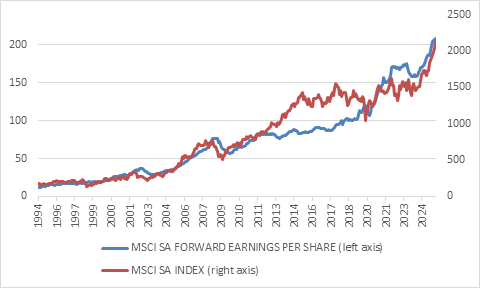
Chart 1: South African equity prices and earnings
Source: LSEG Datastream
The blend of local and international companies on the JSE continues to display steady profit growth despite a sluggish South African economy (more on this below).
The recent increase in precious metal prices has undoubtedly played a role, with gold rising by 38% year-to-date and platinum by 50%. The uptick in local equities this year is supported by strong earnings growth, and analysts expect this trend to continue into the following year. Thus, even with the recent uptick, the local market remains reasonably valued, trading at an appealing forward price-to-earnings ratio of around 10x—a level historically linked to solid long-term real returns.
Bond market uplift
ADVERTISEMENT
CONTINUE READING BELOW
In contrast, the bond market is distinctly focused on South Africa, mainly driven by government issuance. The 10% year-to-date return from the All-Bond Index indicates some local positive sentiment.
Typically, a bond rally can signal trouble, as investors tend to flock to bonds during economic downturns in anticipation of interest rate reductions.
Recent trends in U.S. bonds mirror this sentiment, with disappointing employment figures indicating a potential return to interest rate cuts by the U.S. Federal Reserve.
However, investments in higher-risk markets like South Africa face unique dynamics, particularly with elevated government debt levels. Investors demand a higher yield to counterbalance perceived risks, which can amplify during economic downturns when government revenues are pressured.
Read: South African bonds rally as JPMorgan adjusts index heavyweights.
Emerging economies frequently grapple with the need to hike interest rates during crises to stave off capital outflows, even when local conditions necessitate lower borrowing costs. The alternative risks uncontrollable currency devaluation.
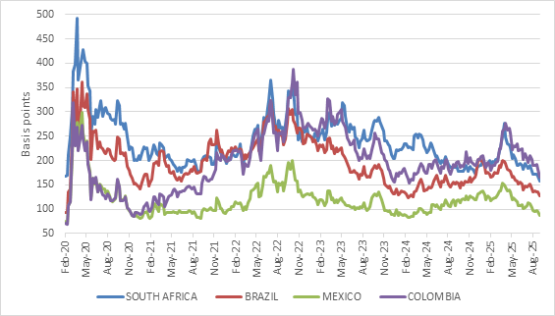
Fortunately, this has not been the case in the local bond market. The South African Reserve Bank (SARB) has cut interest rates by 50 basis points this year, benefiting the short end of the yield curve, while the long end has also gained from a general decline in risk premiums across emerging markets, as demonstrated by movements in credit default swaps.
These credit default swap trends do not yet show substantial improvement in South Africa’s ratings compared to other emerging markets. For that to change, we require stronger economic growth and clearer signs of effective fiscal consolidation.
Chart 2: Five-year U.S. dollar credit default swaps
Source: LSEG Datastream
That said, South Africa is among the few nations actively pursuing fiscal improvements. This focus on tightening expenditures recently resulted in the downfall of France’s government and the appointment of its fourth prime minister within a year.
In the U.S., fiscal discipline seems to have waned, although tariffs are generating extra tax income. Should the Supreme Court partially block these tariffs, it might alleviate the burden on businesses and consumers but broaden the deficit.
Advancements but not perfection
At this point, fiscal consolidation cannot rely solely on cutting spending or raising taxes, as both are politically unpopular and could negatively impact economic performance. Improving efficiency at the South African Revenue Service (SARS) has limits. Genuine economic growth is crucial for naturally boosting tax revenues.
Read: Rocks, hard places, and everything in between.
ADVERTISEMENT:
CONTINUE READING BELOW
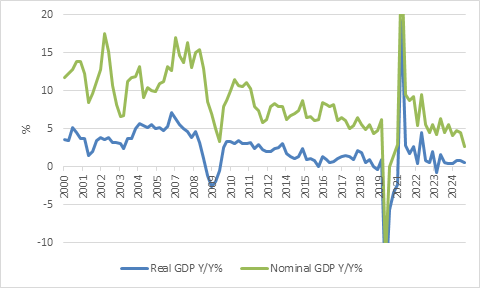
The latest developments show a mixed scenario. After remaining stagnant in the first quarter, real gross domestic product (GDP) growth rose to 0.8% in the second quarter. Better, yet still not satisfactory. In real terms, the economy was just 0.6% larger year-on-year in the second quarter.
From the government’s perspective, nominal growth—adjusted for inflation—was only 2.5% year-on-year. This number essentially reflects the general income growth in the economy available for tax collection. This figure must rise for tax revenues to increase naturally.
Chart 3: South African economic growth
Source: Stats SA
This suggests that the GDP deflator—a comprehensive inflation measure encompassing producers and consumers—registered only 1.4% year-on-year in the second quarter, the lowest since the 1970s.
While likely indicative of a cyclical low, it implies that maintaining a 3% inflation target is entirely attainable. Nevertheless, the SARB will refrain from further rate cuts until assured that inflation and inflation expectations stabilize around 3%. Some analysts have proposed that aggressive rate cuts now could invigorate the economy.
Nonetheless, this strategy is effective only if the core issue is lack of demand rather than supply-side constraints. Fortunately, demand seems to be improving gradually, with consumer spending growing nearly 3% year-on-year in real terms during the second quarter.
Moreover, credit growth appears to have bottomed out, suggesting that although interest rates are high, they are not suppressing consumer demand. One key mortgage lender recently reported a spike in applications, adding to the evidence of strong demand. Additionally, new car sales growth remains robust, according to industry body Naamsa.
Read: The stock market is not the economy.
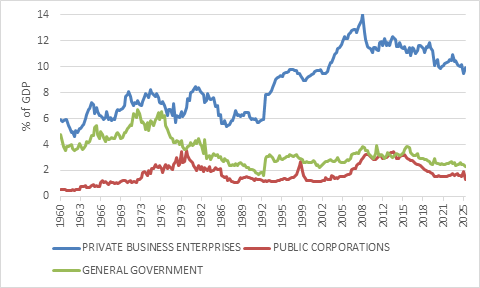
Where demand is lagging is in fixed investment, which remains below pre-COVID levels in real terms and constitutes about half of the 30% GDP benchmark needed for rapid economic growth. While interest rates do influence fixed investment choices, the scale of the opportunity is likely the leading determinant.
Future confidence is crucial, particularly trust in the stability of the regulatory and political environment.
This also includes the lingering instability of U.S. import barriers that continue to challenge various businesses. Companies need assurance regarding rule of law, protection of property rights, and the safety of their personnel and suppliers.
Chart 4: South African fixed investment spending
ADVERTISEMENT:
CONTINUE READING BELOW
Source: Stats SA
On a brighter note, new opportunities are cropping up in sectors previously dominated by the state. With the progressive deregulation of the electricity market, eleven companies have been selected to manage their own trains in Transnet rail corridors. Once fully operational, these shifts will unlock substantial private sector investments in rail infrastructure, boosting trade volumes and export revenues.
This signals a promising shift in South Africa’s narrative: after decades of state control over critical sectors such as electricity and transportation, there is a transformation underway that welcomes private sector involvement.
Listen/read: Treasury, SARB, and the goal of inflation targeting.
Whether the South African government can fulfill its role in providing essential public services like safety and security is still uncertain. While conditions are unlikely to worsen further, the upcoming inquiry into SAPS (South African Police Service) will be a pivotal juncture. The private sector views challenges as opportunities for profit; thus, other pressing issues must be addressed by the government and civil society.
No country is perfect, and those who await absolute perfection before investing will not only wait indefinitely but also overlook valuable opportunities.
Investments are usually most fruitful when sentiment is low, and pessimism prevails. During such times, the likelihood of unexpected positive results is greater than negative outcomes. Conversely, during more optimistic periods, such as the current fascination with artificial intelligence, the opposite is true.
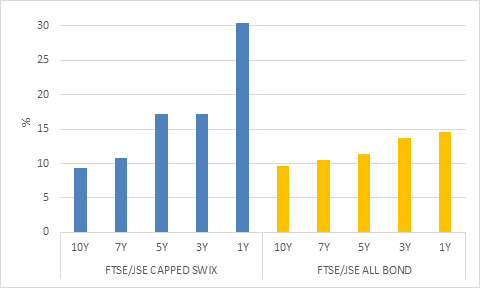
Reviewing Chart 5, the 10-year return metrics for local bonds and equities appear subdued, but recent periods reflect encouraging trends. Returns for 2025 look promising. Investors who have endured the challenges posed by local political instability and sluggish economic growth have ultimately seen their perseverance rewarded.
Chart 5: Annualized returns for South African asset classes
Source: LSEG Datastream. As of 31 August 2025.
As domestic valuations stay reasonable and economic growth is anticipated to gradually rise due to reforms, the outlook for real returns appears optimistic. However, the remarkable returns seen in 2025 are unlikely to occur again in the short term. Over time, achieving a lower inflation target is expected to lead to lower interest rates, enhancing the appeal of both bonds and equities and diminishing long-term downward pressure on the rand.
That said, diversification remains vital—managing risk and uncovering new opportunities. Just be cautious not to develop your investment strategy based solely on mainstream news.
Izak Odendaal is an investment strategist at Old Mutual Wealth.
Stay updated with Moneyweb’s comprehensive financial and business news via WhatsApp here.


