

This year has seen a shift among investors towards small-cap stocks as a means of lessening their dependence on the concentrated AI sector. Nevertheless, the rising interest rates might be challenging this approach.
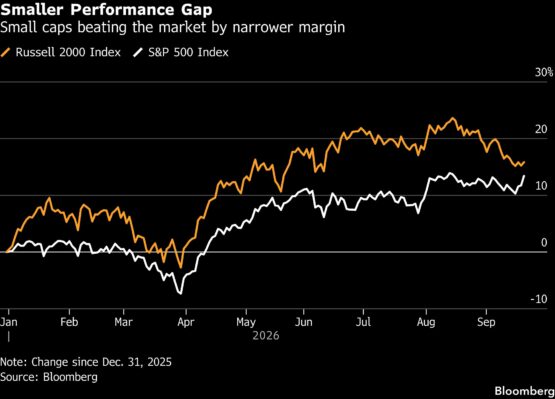
The advantage of the Russell 2000 Index over the S&P 500 has diminished from 11 percentage points in June to merely 2 percentage points this week. As the market braces for further interest rate hikes, concerns are growing over the difficulty in managing inflation, casting a shadow on the outlook for small-cap companies, which are typically considered one of the riskier stock categories.
Lisa Shalett, CIO at Morgan Stanley Wealth Management, noted in a client update, “The largely performative hikes are not expected to adversely affect earnings, which are the primary driver of S&P 500 gains, nor to drastically reduce inflation.” She also remarked on “marginally cooler growth in already-weak sectors, such as housing, regional bank lending, and small caps.”
Read:
Dogs, hawks and cockroaches
Fed raises rates, signals another hike as inflation persists
“This implies that any broadening in the equity market is likely to wane, reverting to a more concentrated AI/Magnificent Seven-driven market along with a resurgence of economic imbalance,” she added.
ADVERTISEMENT
CONTINUE READING BELOW
The Russell 2000 has dipped below its 50- and 100-day moving averages, while larger stock indices continue to stay above their support levels. Despite a rally on Monday, the small-cap index remains 2% under its 100-day average. However, even with this recent decline, the Russell 2000 is on track for its best annual performance in a decade relative to the S&P 500.
“For about a year and a half, we’ve experienced a phase where lower-quality small caps have been thriving, and that performance has been quite prolonged,” highlighted Jill Carey Hall, equity and quant strategist at Bank of America. She advised investors to “avoid more leveraged and interest-sensitive small caps in light of the Fed’s rate hikes.”
This could be a daunting task, as some of the highest-performing, quality stocks have been removed from the index, rendering the average stock in the small-cap sector less substantial and more sensitive to interest rate fluctuations.
Bloom Energy, Credo Technology Group Holding, Sterling Infrastructure, and TTM Technologies accounted for two-thirds of the Russell 2000’s gains by June 29, when they were transferred to the Russell 1000 Index.
ADVERTISEMENT:
CONTINUE READING BELOW
“The performance of small caps during the first half was noticeably more focused than usual,” commented Hall. Looking ahead, she anticipates that mid-caps will outdo small-caps due to the recent index rebalancing and the uptick in interest rates.
Moreover, several stocks that benefited from the AI surge, including Credo Technology Group Holding and Fabrinet, were also removed from the Russell 2000.
“With the interest rate landscape and the transformation in AI composition becoming less favorable, we foresee ongoing downside risks for small caps,” noted Stefano Pascale, a strategist at Barclays Plc. He suggested that investors hedge against significant rate impacts on small caps through bearish Russell 2000 put spreads.
Stefano attributed the narrowing performance gap between large and small-cap stocks to the July release of the FOMC meeting minutes, which prompted traders to revise their interest rate expectations.
Nevertheless, optimism about robust earnings growth in the Russell 2000 has overshadowed worries regarding rising rates for a good part of the year. Recent data from Jefferies indicates that small-cap stocks recently experienced their fastest earnings growth quarter since 2022.
Andrew Tyler from JPMorgan Chase & Co is among those choosing to steer clear of small caps for now. The head of global market intelligence at the bank favors larger stocks, emphasizing that “small caps continue to be under pressure,” as noted in a client communication on Monday. Tyler pointed out that fund flows from professional money managers signal greater risks for the Russell 2000 compared to the S&P 500 and Nasdaq 100.
On Monday, the Russell 2000 increased by 0.5%, trailing behind S&P 500 gains and further narrowing the performance gap between small and large stocks this year.
“Undoubtedly, small caps have lost their leadership role in the market,” stated Jeff Jacobson, head of derivative strategy at 22V Research.
© 2026 Bloomberg


