

The $4 trillion-a-day currency swaps market is working to lessen its reliance on dealers making phone calls, with trading platforms seeking to automate this historically manual aspect of foreign exchange.
Approximately 56% of FX swaps are executed electronically, which falls short of the about 71% seen in spot transactions, as noted by the Bank for International Settlements. This gap is particularly striking in the inter-bank market, where traders often rely on voice brokers to handle large positions.
There is now a renewed push to shift more of this business to electronic trading, as showcased at a recent industry event in Amsterdam. Technology provider 360T predicts a rise in trading on its electronic platform in the upcoming year, while London Stock Exchange Group Plc is set to roll out a clearing solution.
Market structure consultancy Positive Sum Associates has reported that at least three venues are creating dealer-to-dealer swaps platforms.
“The race is on,” stated Jasper Livingsmith, founder of Positive Sum Associates and former head of G7 portfolio management at the European Bank for Reconstruction and Development. “I find it surprising that such an old, traditional marketplace is still so primitive.”
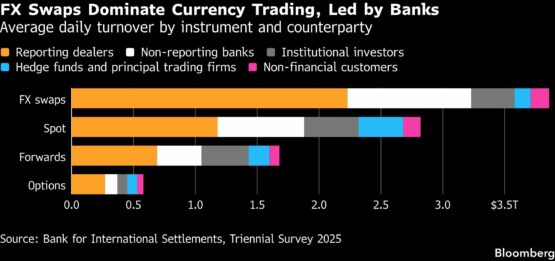
Automating FX swaps entails unique challenges, as these transactions involve two currency exchanges on different dates and are influenced by the extent of credit banks are willing to extend to one another.
ADVERTISEMENT
CONTINUE READING BELOW
Although increased automation may pose risks to some broker roles, reducing trading costs remains a pivotal objective in the largest segment of the currency market.
According to Alexis Cayla, head of quantitative G-10 short-term interest-rate trading at JPMorgan Chase & Co., advocating for the “electronification” of the dealer-to-dealer swaps market is crucial for primary liquidity providers.
The US bank is navigating this transition itself, but the overall pace of change in the industry will depend on other banks’ readiness to adapt.
Read: Ignoring tech issues costs financial services industry millions every year
Still human
This narrative is familiar. Conference attendees have long expected that FX swaps would ultimately transition to electronic trading, similar to spot transactions. However, many participants in Amsterdam were hesitant to make this assertion again, having seen the industry repeatedly claim that change was imminent.
Some still value human interaction within currency markets. Panelists voiced concerns that fewer individuals are participating in phone discussions nowadays, while AI-generated summaries might make communication feel less personal.
ADVERTISEMENT:
CONTINUE READING BELOW
Others humorously suggested that AI bots could be programmed to chat about the latest football scores to fill the gap left by fewer social interactions with brokers.
Read: Microsoft launches AI that works like an executive assistant
Some funds have already begun automating smaller swaps transactions. Ian Packer, an FX trader at UBS Asset Management, indicated that up to $500 million in major currencies can now be processed electronically, while larger transactions still require direct calls.
“For significant swaps, we frequently need to execute manually because the banking counterparts we work with do not have sufficiently advanced systems,” explained Richard Turner, senior trader at Insight Investment. “We are keen to implement more automation.”
Bloomberg LP, the parent company of Bloomberg News, operates a currency trading platform that incorporates swaps.
© 2026 Bloomberg


