

A growing consensus suggests that extracting carbon dioxide from the atmosphere is vital to mitigate the severe consequences of climate change.
As world leaders gather in New York for the United Nations General Assembly and the annual Climate Week NYC, one pressing question remains: Who will finance the CO2 removal?
Adair Turner, co-chair of the Energy Transitions Commission—which includes executives from companies such as ArcelorMittal SA, HSBC Holdings Plc, and Shell Plc—notes that carbon removal does not offer the same economic advantages as other technologies like electric vehicles.
“When it comes to removals, it’s never going to be a win-win,” remarked Turner, who previously led the UK’s financial regulatory body, in an interview. “The goal is to eliminate emissions, which means someone has to shoulder the cost.”
According to a report from the Energy Transitions Commission, scaling up carbon dioxide removal is one of four critical environmental goals that remain unachieved, amidst a landscape where global temperature increase limits are being missed.
ADVERTISEMENT
CONTINUE READING BELOW
Read:
UN warns that global warming may soon surpass 1.5C, reaching at least 1.8C
Eskom retracts pollution promise, risking World Bank unease
Carbon dioxide emissions are projected to set a record this year
This month, the UN indicated that the world is likely to exceed the 2015 Paris Accord’s benchmark of limiting global warming to 1.5C above pre-industrial levels in the next few years, with current policies enabling about 2.6C of warming.
The UN asserts that some degree of carbon removal is now essential to bring temperatures back to the 1.5C target, a statement interpreted by industry advocates and project developers as official acknowledgment of the necessity to reduce CO2 levels.
Carbon removal includes deliberate human technologies, practices, and methods made to extract CO2 from the atmosphere and store it permanently—or for extended periods—in rock formations, oceans, soils, trees, or manufactured goods.
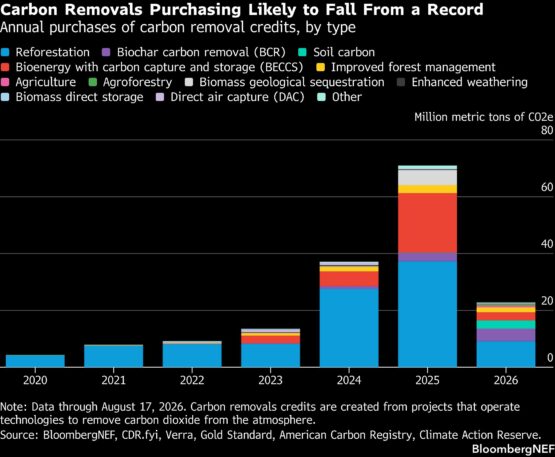
Demand for carbon removal credits has fallen in 2026, with only 23 million credits purchased as of August 17 this year, according to a BloombergNEF report from last month. This reduction was largely driven by decreased purchases from Microsoft Corp., the leading buyer in the market.
ADVERTISEMENT:
CONTINUE READING BELOW
The other three shortcomings identified by the Energy Transitions Commission include the stalled phase-out of coal, insufficient progress in curbing methane emissions, and the inability to stop deforestation. While strides are being made in areas like EVs, solar energy, batteries, and nuclear power, resolving these more complex challenges is crucial, Turner noted.
“Even if every vehicle on the planet converted to electric overnight, failing to address methane emissions, deforestation, phasing out coal, and initiating carbon removals would prevent us from achieving a temperature increase of 1.8C, much less 1.5C,” he stated.
On the topic of carbon removal, Turner stressed the importance of funding from governments, businesses, and philanthropists, with governments taking the lead. “I’m not ruling out the possibility that we’ll accomplish this, but we have a considerable journey ahead of us,” he added.
© 2026 Bloomberg


