

Shein Global Holdings has reported a modest 1% growth in net revenue for the first half of 2026, representing its inaugural performance as a publicly listed entity. The online fashion brand is grappling with challenges, including reduced consumer demand and increased expenses.
On September 1, Shein officially began trading on the Hong Kong stock exchange, and in a filing released on Monday, it disclosed a staggering 52.9% drop in operating income compared to the first half of 2025. This downturn continues the trend of declining profitability first noted in the previous quarter.
In its initial public offering (IPO) filing, Shein had warned that the ongoing conflict in Iran would adversely affect its performance in the first half. The company anticipated that its revenue growth would closely mirror the 1.1% growth seen in the first quarter but with a marginally lower operating margin.
This announcement follows Shein’s public debut, which culminated a lengthy and frequently postponed path to the stock market. The firm is currently valued at approximately $26 billion, a stark contrast to the nearly $100 billion valuation it reached at its peak in 2022.
“We expect the external landscape to remain unpredictable in the latter half of 2026, with ongoing tariff issues and fluctuating logistics costs,” the company remarked in its interim report. “Nonetheless, the fourth quarter, featuring significant events like 11.11, Black Friday, Cyber Monday, and the Christmas season, is our critical promotional window and should drive a significant uptick in orders.”
Shein is facing declining revenue growth and profitability compared to the previous year, heightening the pressure on its executives to reassure investors as the stock trades nearly 27% below its initial offering price. The retailer is confronted with slowing demand, rising costs, and increasing regulatory scrutiny.
Challenges to Growth
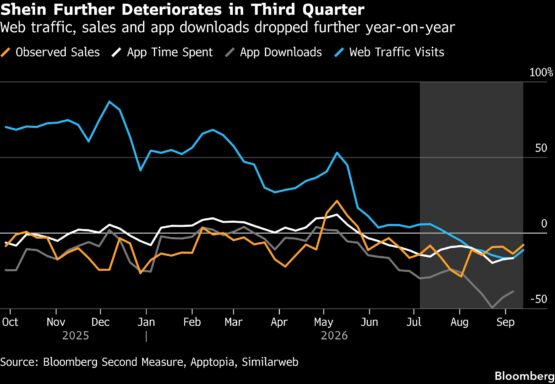
Early signs indicate a continuation of weakened performance into the third quarter. Data from third-party sources, discussions with major suppliers, and analyst predictions suggest that conditions have worsened, particularly characterized by softer sales in the U.S. and a decline in global site traffic. This situation underscores the urgency for Shein to expedite the expansion of its new ventures to make up for declines in its core ultra-fast fashion segment.
ADVERTISEMENT
CONTINUE READING BELOW
“Without a clear strategy to address short-term growth challenges, reversing the long-term downward trend will be challenging,” asserted Shen Meng, director at the Beijing-based investment bank Chanson & Co.
Further indications of third-quarter weakness will likely amplify investor concerns regarding Shein’s long-term growth trajectory, according to Shen.
According to Bloomberg Second Measure, which monitors credit and debit card transactions, Shein’s U.S. sales fell by over 10% in the three-month period leading up to August and early September, representing a sharper decline than the single-digit drop seen across the broader specialty online retail sector.
Since late last year, Shein’s sales have trailed the broader apparel market in the U.S., while competitors such as PDD Holdings Inc.’s Temu and Amazon.com Inc. have enjoyed single- to double-digit growth since April.
Two primary suppliers from China told Bloomberg that their orders from Shein have decreased by roughly 20% in the third quarter, with orders dropping further in August and September, according to these suppliers who wished to remain nameless.
Shein has not provided any comments on these recent developments.
Furthermore, other indicators highlight difficulties in both attracting and retaining customers. Global web traffic to Shein experienced a year-over-year decline in August, marking its first downturn since late 2024, as reported by Similarweb.
ADVERTISEMENT:
CONTINUE READING BELOW
Additionally, the time users spent on Shein’s platform decreased by over 10% in July and August, while app downloads plunged more than 40% in August, according to Apptopia.
Some of this decline may reflect a broader downturn in e-commerce. The two suppliers also reported a similar decline in business with Temu, whose global web traffic has diminished since March. There has also been a reduction in user engagement on both Temu and Amazon over the summer. Temu has not yet responded to inquiries for comment.
Moreover, regulatory changes and cost pressures complicate Shein’s challenges. France instituted new fees on ultra-fast fashion items starting September 1, while the European Union, a key market, ended its de minimis customs duty exemption in July.
Bloomberg Intelligence analysts Catherine Lim and Jason Zhu estimate that Shein’s revenue growth will slow to about 2.5% in 2026, with adjusted operating profit decreasing by more than 19% due to rising oil and shipping costs exacerbated by the conflict in Iran.
Ultimately, the pivotal question remains whether this decline is temporary. According to Lim and Zhu, third-quarter sales will be “the key test.”
© 2026 Bloomberg


