

Nvidia is on the verge of becoming the first company to reach a $6 trillion market capitalization as investors redirect their attention back to the AI chipmaker.
The stock has reached a new all-time high following the company’s robust revenue forecast and the announcement of the largest stock buyback in history, leveraging a valuation that is close to multi-year lows. These two aspects—strong growth and an attractive valuation—are particularly significant, especially as investors contend with elevated interest rates and weak economic indicators.
“Nvidia is appealing for its growth potential as well as its value proposition, serving as a safe haven from the potential damage that higher rates could do to the economy,” explained Jim Awad, senior managing director at Clearstead Advisors, an Nvidia shareholder. “This makes it a compelling choice for those wary of the current economic climate.”
The stock has soared 28% this year, adding $1.2 trillion to Nvidia’s market capitalization, which is now just under $5.8 trillion. The company is also the top contributor to the S&P 500 Index’s 14% growth in 2026.
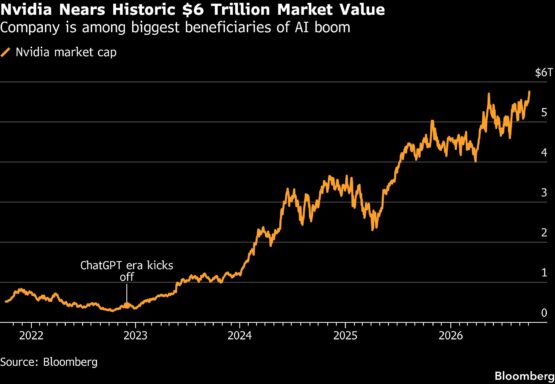
This turnaround is particularly notable given that the stock was down 11% earlier this year on March 30, as investors questioned the significant investments being made in AI infrastructure. Since then, the sentiment surrounding the AI sector has shifted, with critical discussions around its potential risks now taking center stage. At the same time, inflation concerns and the likelihood of interest rate hikes by the Federal Reserve have made large tech companies like Nvidia appear relatively stable to investors.
“As worries about rate increases have materialized, capital has begun to flow into these megacap tech stocks because they seem somewhat more resilient to such changes,” said Larry Tentarelli of Blue Chip Daily, noting that the semiconductor sector has also seen a significant rebound, fueled by Meta Platforms Inc.’s Muse AI initiative. There’s been a “major shift back into semiconductors, a significant rotation into megacap stocks, and both trends favor Nvidia.”
ADVERTISEMENT
CONTINUE READING BELOW
The allure for investors was further emphasized by Nvidia’s decision to authorize an additional $150 billion for its ongoing share repurchase program, which CEO Jensen Huang stated “reflects our confidence in the long-term prospects ahead.” He has previously referred to Nvidia as “the world’s first and only growth value stock.”
Wall Street typically favors buybacks as they provide returns to shareholders and reduce the number of outstanding shares, thereby increasing earnings per share. Nvidia’s repurchase strategy is particularly noteworthy among Big Tech firms that primarily allocate their cash for AI investments, with Apple Inc. being a notable exception.
The buyback “is exactly what investors want to see,” as it indicates the company “sharing its substantial profit margins with shareholders,” wrote Mizuho Securities analyst Jordan Klein in a note to clients on Sept. 28.
While some critics contend that buybacks merely inflate earnings per share without driving organic growth, this viewpoint does not apply to Nvidia. In its most recent report, the chipmaker projected sales growth of 70% for fiscal 2028, significantly surpassing the previously anticipated growth of 45%.
“The ability to execute such an extensive buyback is evidence of its rapid growth, resulting in abundant capital,” said Clearstead’s Awad. “Nvidia remains at the forefront of an AI revolution that appears to be ongoing, and the demand it is experiencing seems largely unaffected by rising rates, bolstering confidence in its continued sustainability.”
Nvidia’s net income is expected to double in fiscal 2027, ending in January, with revenues projected to increase by 90%. This represents a 65% increase for both metrics compared to the previous year.
ADVERTISEMENT:
CONTINUE READING BELOW
Despite these accomplishments, Nvidia still lags behind the broader semiconductor sector this year. The Philadelphia Stock Exchange Semiconductor Index has surged by 86% in 2026, driven by companies like Micron Technology, Marvell Technology, and Intel Corp, whose stock prices have more than doubled, even as they trade below the record highs reached earlier this year.
Nvidia’s challenges are partly attributed to market dynamics—it is currently the largest stock globally, necessitating substantial activity to cause significant shifts in a stock that has consistently outperformed in the S&P 500 over the last decade. Will this growth be sustainable?
This question is central to why the stock is currently trading at approximately 17 times projected earnings for the next 12 months, approaching its lowest level in a decade and trading at a discount to the S&P 500 Index, which is valued at 19 times forward earnings.
“Nvidia is an attractive option, but the challenge is that it’s becoming a casualty of its own success,” Tentarelli noted. “It requires considerable activity to change the stock’s trajectory.”
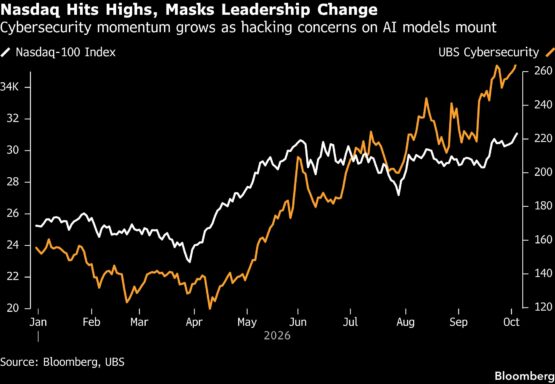
Tech chart of the day
© 2026 Bloomberg


